Wednesday, December 15, 2010

You Can't Live Forever...

But that doesn't mean you have to stay dead. Dawn of the Dead (1978) proved for a second time that the dead don't like the idea of an eternal dirt nap anymore than we livings do. This time 'round Romero came equipped with an inflated budget and a reinforced political agenda.

All Weapons Half Off! Just Three Easy Payments!
Again set in small town PA, Dawn captured the spirit of the American economy. The allegory of the American drone and the symbolism of the mall are almost too obvious. The film's classic and simple message has managed to stand the test of time though, still studied by academic cinephiles and worshiped by the Fangoria crowd.

Despite cementing a place in horror history, not even Dawn could escape the momentum of the remake movement.

MJ wasted his allotted undead time while he was alive. But it was the 80's, everyone was doing crazy things

Turbo: A Zombie Fighters Movie (click me)

Since the world gone and got itself in such a hurry, the remake of Romero's classic needed to be supercharged. Zach Snyder, creator of 300 and god to frat bros the world over , took the helm. And supercharge he did.

While remaining close to the original picture, he toyed with the mythology. The zombies learned to sprint a la 2002's 28 Days Later. The method of transferring zombification to another became quicker, but now required contact. Romero was not impressed. Audiences, however, were surprisingly receptive to Snyder's overhaul.

A Strange Case
Not often in this industry does a film series see a remake produced before the run of original pictures is finished. Nor do sequels typically get remade before the original film. Both apply to Dawn of the Dead.

Romero, in fact, is still pumpin' out undead films. Most recently 2010's Survival of the Dead. Zach Snyder used zombies as a launchpad into the studio system, but Romero, try as he might, just can't seem to get away from his undead creation. Just a classic case Frankenstein syndrome. Complete with an emphasis on slow, hobbling undead human monsters.

Wednesday, December 1, 2010

The American Deadvolution

In 1968, death consumed the culture. While we tragically lost politicians, soldiers, and civil rights leaders, George A. Romero gave birth to a new genre of film in a secluded Pennsylvania farm house. Night of the Living Dead spawned countless spin-offs, sequels, remakes, and re-releases. A zombie film, the first of its kind, with a simple concept: When there's no more room in hell, the dead will walk the earth.

By George, He's Done it Again!
Ten years after the release of the original zombie classic, Romero released a follow up: Dawn of the Dead. It was worth the wait. Widely considered one of best horror films of all time, it joins it predecessor on Empire Magazine's list of the 500 best films ever made. Not bad for a film that takes place in a mall.

In true Romero spirit, Dawn of the Dead is about more than a few survivors fighting off their dead neighbors. Set in a mall, the film serves as an allegory for American commercialism and consumption. Hence why the risen instinctively flock to the shopping mall. I guess death, like life, is better with Orange Julius.

Proof the dead don't always stay that way.
Dead And Gone And Can't Get Rid Of Them
Zombies are everywhere these days. You can't swing a chainsaw without hacking off the limb of a dead relative. Video games, movies, toys, comics, TV, you name it, they've moaned and roamed in or around it. Romero's film was more than the kick-start of a film franchise, it was the Dawn of the Great American Deadvolution.

We'll Be Back Like The Buried
Next time we'll look at differences between Zach Snyder's vision of the film and the classic sequel. The fast pace and attacking nature of the remake earns it the rare distinction of worthwhile redo. But has the message about mall-loving Americans as mindless monsters changed? Stay tuned.

Tuesday, November 23, 2010

Real-ly Scary: Fact, Fiction, and Chainsaws

The following is "real" crime footage from the epilogue and prologue of 2003's The Texas Chainsaw Massacre.


That Sweet Boy...
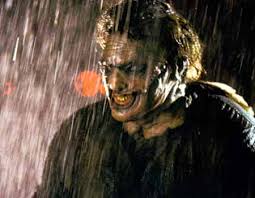
I'm awful tired of delusional old locals telling me that the town maniac is just a sweet misunderstood boy. Thomas Hewitt, to be fair, did it first. Before Jason and Michael. The result of a Maury-worthy fucked up childhood, Leatherface took much ridicule from the other residents of Middle-of-Nowehere, TX. When he'd had enough, he began hacking off their faces to wear as his own.

If you can't join 'em, cut 'em up with a gas-powered saw. Despite the mask and chainsaw, what's really scary is that he is a result of a not-so-rare Texas upbringing. Just look at this crazy bitch.

Fact and Fantasy: The Origins of a Legend
When the video above was first screened, it caused quite a buzz on the web. People argued the degree of validity. Were the tapes real? No, but really well done. Did Thomas Hewitt exist? No. Has anything like this ever really happened? Sort of.

Leatherface is the bastard child of urban legends and real life criminals. The most famous being Ed Gein, who also inspired Norman Bates. Gein was a madman with nearly twenty murders on file, the creator of the skin-mask, and a strong proponent of necrophilia. Gross.

Wisconsin's Ed Gein: Psycho, Murderer, Grave Robber, Packer Fan.
Gein being the primary influence on two of the most iconic slashers, his place in horror history is unquestionable. A real life monster with a body count that took fictional slashers three sequels to match.

Return of the Living Blog
Next week we'll be tackling another redo I don't hate: Dawn of the Dead. What a treat for all you reader(s). In addition to discussing the second film in Romero's undead franchise and Zach Snyder's remake, we'll also look at oddball Italian pseudo sequel Zombie 2. It features a zombie fighting a shark. No joke. More on that after the holiday.

Sunday, November 14, 2010

Extreme Makeover: Leatherface Edition

In 1974, Tobe Hooper took a chainsaw to conventions of horror cinema. Through the iconic anti-hero Leatherface, The Texas Chainsaw Massacre assaulted the audience with innovative in-your-face gore. A blizzard of bloodlust and bizarre. More an experience than a motion picture.

Three decades later, the film was predictably remade. Surprisingly, the new polished take proved to be a frightening and worthy heir to Hooper's classic.

Shit Happens.
Just as the bumper sticker on the back of ill-fated van says. A major reason TCSM is so shocking is the realism. The original film makes a case for authenticity with shaky camerawork, eulogistic voiceover, and a lack of structure, more of an incident caught on tape than a narrative film. All of this is done make the audience believe that this could happen to them.

The reboot takes it further. In addition to the techniques borrowed from the original, we see "authentic" police footage, documents, and an epilogue. The film suggests not only that this could happen, but it already has.

Ed Gein + Folklore + Antique Effects = Truth = It could happen to you.
The Times They Are A-Changin'
In the 70's, gore flicks were underground. If you wanted to make a movie with naked beauties slaughtered by a masked maniac, you were doing it without the backing of a major studio. These rogue filmmakers soon caught the attention of mainstream distributors. I mean, how could one really ignore a six-foot speedster madman with a mask sewn from his victims.

Original films like Elm Street, Friday the 13th, and The Texas Chainsaw Massacre were made entirely independently. Thus they strayed from conventional studio storytelling. The TCSM remake came during a second wave of studio horror films. Thus the new film took a film that broke the mold and boxed in a polished studio package.

The sun will come out tomorrow, but you'll still be missing a leg.
While maintaining the visuals from the original set, the reboot kicks it up a notch in detail. Bam! Grimy, dark, dusty, and disturbing, The Texas Chain Saw Massacre proved those who doubt a major studio could ever put together a worthwhile horror remake (usually including REELapse) wrong.

Just Keep Telling Yourself, "It's Only A Movie. It's Only a Movie..."
In the next post, we'll examine the psychology and mythology in the films. We'll also try to figure out where the hell Leatherface came from. Or maybe hell is the simple answer. Serious examination awaits.

Sunday, November 7, 2010

A Sequel A Day Keeps The Doctor Away.

Or in the case of Halloween III: Season of the Witch, an absence of your series' central character keeps the audiences away. For those of you not terribly well versed in serial horror cinema, you may not know that Michael Myers, the star attraction of the Halloween pictures, was omitted from the third film. This puzzling move was done in an attempt to make the Halloween series an anthology of horrifying tales rather than overplay Michael. Turned out to be a worse mess than the victims of ol' Mike himself.

Quite the opposite problem came with Rob Zombie's reboot. Too much of a good thing can spoil it. Turns out, same goes for too much of an evil thing.

Michael Myers: Man or Bogeyman? 
To humanize or not to humanize, that is the question faced by all great horror filmmakers. When creating the face of evil that will stalk your protagonist and her friends, the creator must ask themself if they want the audience to feel for the foreman of their fears. John Carpenter clearly did not want the audience to relate with his monster. His turn to murder, unexplained and unprovoked, came packaged in a iconic thirty-second introduction.

The events covered in the original film's opening sequence stretch out over nearly forty minutes in the remake. In that time, we find motivation and explanation along with a dysfunctional family. Further, this time Michael talks. A lot. In this time we see a soul evaporate. While this strikes a cord in "realism" by creating a sense this or something like it could actually occur, it is much less horrifying than pure elemental evil.The way Michael Myers was meant to be.
Behind this mask is just a scared little boy. Someone named Zombie decided that was more terrifying than the Devil. Go figure.
It's All So Sad!
Zombie's film is less of a scare flick and more a melodrama. Far too much time is spent on presenting the cause for Michael's turn to evil. Upon his turn to darkness, he immediately kills one of his only three friends in the world by hurling a TV at him. I can't make this shit up. Really. Why spend 50 minutes humanizing a monster only to have his first act as an adult be entirely inhumane?

Zombie goes for the Frankenstein effect and begs for sympathy for his monster. The difference, and the problem, in this film is that Michael kills a lot of innocent people. Frankenstein didn't hurt anyone. Michael Myers is a murderous psychopath. He is thoroughly unlikable as well he should be. No matter how much time you waste trying to convince me otherwise. (51 minutes 31 seconds)

Another black-eyed, white-faced, long-haired Michael with Daddy issues. 
Who Will Survive? And What Will Be Left of Them? 
REELapse is headin' on down to Texas! Just when ya'll thought it was gon' be a good ole-fashioned swing dance of a time, the chainsaw revs up. It's all fun until someone loses an eye. And a leg. And an arm. Then a couple of heads. Leatherface is wreckin' up the joint as we explore The Texas Chainsaw Massacre(s).
Blood?
Allusions to real-life killers?
It's all here!
There's nothing to lose... other than your limbs.

Wednesday, October 27, 2010

The Tale of Two Terrors: The Michael Myers Stories

Movie Theme Songs - Halloween Theme .mp3
Found at bee mp3 search engine
(The best horror score ever. Better than Psycho, you ask? Listen and believe. Read through and allow the music to play, save the links for after so it plays uninterrupted. Links for cyber dessert. Mmm.)

"Don't you think we could refer to 'it' as 'him'?" Asks a new nurse en route to his first encounter with a patient named Michael Myers. His doctor since being brought in as a young child, Dr.Loomis replies simply, "If you say so." This moment defines Michael Myers, the boy with devil's eyes and an empty soul. Famous for hacking his sister to a gruesome death with a kitchen knife. The boy who grew up to the be the face of a franchise. With John Carpenter's classic Halloween, Michael became role model for the likes of Freddy, Jason, and Chucky. And eventually, under the direction of Rob Zombie, an inspiration for a new incarnation of Michael Myers himself.

"He's Gone Now. Gone For Good!"
Loomis proclaims after Myers escape from the asylum. But was he ever really 'there' at all? Or has he always been out of touch with humanity. In Carpenter's original film, Loomis reveals to us much about his experience with the troubled boy, but we never know him as a person. Myers is elemental. A pure force sent by the filmmaking gods to create chaos and fear. Lost in the indulgence of Rob Zombie's Halloween is the fact that Michael Myers is not a person. He is the bogeyman. A hurrcanic force of pure evil. You don't understand him. You fear him. And then you fucking run. (Don't fuck and then run, that never works out in these pictures) A common misconception is that no quality film can feature a shadow character as a primary pro/antagonist. Michael Myers, in Carpenter's film, is an exception to that theory. And he isn't the only one to have disproved it.

This kid has issues bigger than that kitchen knife.
"Michael Myers Begins"
That's what the name of Zombie's Myers' tale should be. He gives us the familiar story of Laurie Strode and the night he came home. Unlike the original, he gives a detailed backstory of the killer. While the information given is interesting it detracts from Michael's icon. I don't care what he was up to years ago. I don't want to know. The beauty of Carpenter's simplicity is that it allows the audience to draw their own conclusions, create their own nightmares, about Haddonfield, Illinois' most infamous son.

The Horror! The Horror!
Next post, REELapse will discuss the merits of the Halloween films in terms of scares. Because, after all, horror movies should be horrifying. If they don't get your girlfriend to cuddle a little closer than someone didn't do their job. These films share a story, but garner scares in different ways. Zombie's serves up well built-up scares, providing the background necessary to appreciate the jump scenes. Carpenter gives you the tools to find the horror in his film.

Saturday, October 23, 2010

Just Because You Can, Doesn't Mean You Should: The Story of Tim Burton's Wonka

Tim Burton's Charlie and The Chocolate Factory held the promise of a worthwhile remake. A story deserving of a second breath with the right ingredients and a unique spin. Forums were alive with hopes Burton wouldn't hold back on the dark tone for which he is known. The first Wonka was oddly terrifying, but this one would be scary on purpose. Sadly, when finally released in 2006 the film was happy-go-lucky letdown.

Grandpa Joe Shoulda Stayed in Bed
Let's begin with the merits of Burton's re-envisioning of Charlie's tale. It's a more accurate adaptation of the book. Johnny Depp isn't all bad. Pretty colors. With that out of the way, it is a total failure to live up to the original film. One could argue that's not the point, that this is strictly a book adaptation. To you, one (or Jeff), I say that REELapse is a film blog thus that is the point here, even if not the intention of the filmmakers discussed. You have to go forward to go backward and all that. Pressing on. The new film simply reveals too much. By adding depth to elemental or fantastical characters in an effort to reinvent them, the filmmakers, in fact, killed their spirits.

Where It Went Wrong
The budgetary restrictions that made the Gene Wilder classic charming held the opposite effect for the Depp film. Burton had nearly unlimited funds. Because of this, we're overwhelmed with CGI and virtual squirrels. In addition to the "A" plot, the new film features in depth background stories for the central characters. This was not explored in the original film. Rather it spent as much time in the factory as possible. And isn't that what the golden fucking ticket was for in the first place? We don't need to know that much about these characters in that way. It's Charlie's story and, in an odd twist of fate, it is the film with his namesake that fails to focus on that. If you're still debating the merit of the films ask yourself what is more interesting:

I love children. Just not the ones that deserve to die.
A recluse madman who runs a chocolate factory fueled by odd little men, the claimed homeland of which probably doesn't exist, who offs the bad children of the world to give a better place to one worthy young person.
Or:
I'm eerie. Like, PG eerie.
A happy candyman with daddy issues passes along his fortune to a poor boy with similar daddy issues. Stupid.

The End of Our Tour
As you can probably tell, REELapse prefers the Mel Stuart original to that piece-of-shit Burton strung together a few years back. I'll end the discussion with a metaphor explaining the difference in the films. The classic is much deeper, more meaningful. While it may look simple at first glance, it is filled with rich undertones and depth. Like a Snickers. Burton's film on the other hand is shallow and flashy. Like a Hershey bar covered with sprinkles. And that's exactly what it is. Nothing more than chocolate and sprinkles.